
SYSTEMATIC FUTURES EXECUTION
Learn the Market. Plan the Trade. Execute with Structure.
Master auction market theory and order flow dynamics. WolfPack unifies institutional market education, context indicators, and the automated NT8 Trade Assistant into a single systematic execution framework.

MARKET STRUCTURE PREREQUISITES
Build the Foundation
Before the Setup
Algorithmic signals without structural literacy produce blown accounts. Master these three foundational disciplines before risking live institutional capital.
PILLAR 01
Futures Foundations
Before interpreting any chart signal, you must understand contract mechanics, leverage math, and precision tick valuations across equity index futures.
- Contract specifications (NQ, ES, YM, RTY)
- Tick increments & precise point-dollar values
- Overnight margin vs. intraday leverage requirements
PILLAR 02
Market Context
Trade triggers only hold statistical edge when aligned with high-timeframe auction direction, liquidity pools, and prevailing session volatility.
- High-timeframe trend vs. mean-reversion regimes
- Dynamic structural support & resistance zones
- ATR volatility profiling & opening range extensions
PILLAR 03
Execution & Risk
A winning statistical system requires deterministic order execution, strictly defined stop limits, and calculated position sizing to eliminate emotional variance.
- Order types: MIT, stop-market, and limit fills
- Slippage mitigation & fast-market routing protocols
- Hard invalidation stops & systematic R-multiple targets
Complete curriculum modules required before live execution room credentials are provisioned.
EXECUTION & RISK PROTOCOL
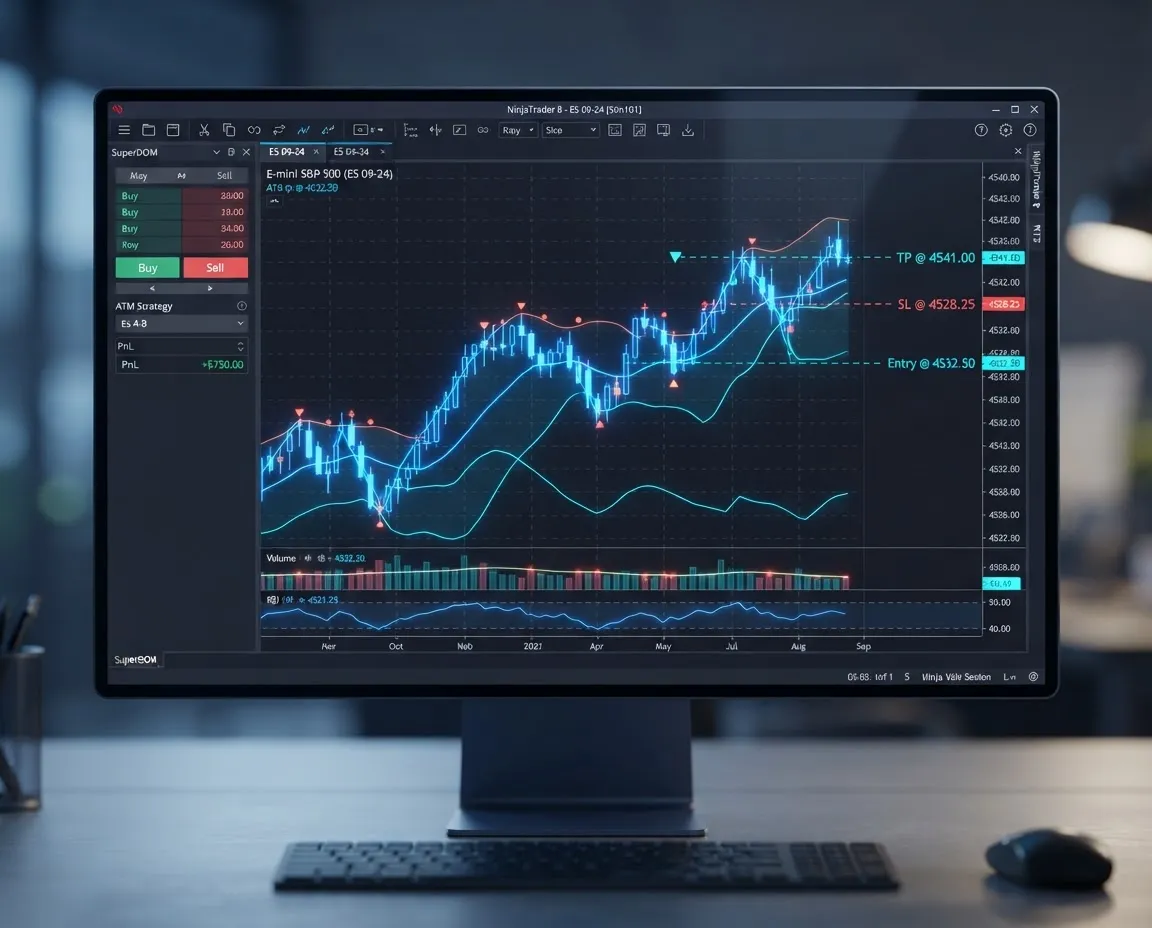
WP Trade Assistant for
NinjaTrader 8
Bridge high-probability market structure directly to active order execution. Engineered specifically for NinjaTrader 8, Trade Assistant integrates multi-condition trigger logic and bracket automation straight into your workspace.
The trader controls configuration and risk.
QUANTITATIVE ARCHITECTURE : INDICATOR SYLLABUS
Learn the Tools -
Not Just the Colors
No indicator produces magical predictive buy signals. Every tool is an abstraction of historical price, volume, or volatility. We teach the underlying mechanics, formula derivations, structural failure conditions, and practical edge cases so you operate as a risk manager rather than a reactive follower.
Exponential Moving Average (EMA)
Calculation & Concept:
A weighted average placing higher geometric decay on recent bars: Multiplier = 2 / (Period + 1). Serves strictly as a dynamic mean representation, not a hard barrier.
Limitations & Mistakes:
Severe lag in high-compression sessions. Common pitfall: treating an arbitrary crossover (e.g. 9/21) as an entry trigger without context of higher-timeframe order flow.
ATR & Volatility Regimes
Calculation & Concept:
Measures market dispersion using True Range: max(H-L, |H-Cp|, |L-Cp|) smoothed over N-bars. Used to scale bracket distance and risk dynamically to current market spread.
Limitations & Mistakes:
ATR carries zero directional bias. Common pitfall: using fixed point stops in varying ATR regimes, forcing exits on normal market noise during volume expansion.
Volume Weighted Average (VWAP)
Calculation & Concept:
Sum of dollar volume divided by total cumulative session contracts: Σ(Typical Price × Vol) / Σ(Vol). Identifies institutional benchmark execution efficiency.
Limitations & Mistakes:
Becomes heavily anchored late in the session due to accumulated volume mass. Common pitfall: treating anchored VWAP touches as automatic reversals during trend days.
RSI & Relative Momentum
Calculation & Concept:
Normalized ratio of average upward vs downward delta over N-bars: 100 - (100 / (1 + RS)). Gauge of velocity, not turning points.
Limitations & Mistakes:
Oscillators peg at extremes during sustained trend runs. Common pitfall: shorting reading >70 or buying <30 inside institutional auction drives.
Support & Resistance Levels
Calculation & Concept:
Cluster nodes of unexecuted limit orders where market participant memory creates liquidity resting points across session highs/lows.
Limitations & Mistakes:
Lines drawn too precisely give false precision. Common pitfall: assuming old levels hold forever, failing to understand liquidity sweeps before directional continuation.
Consolidation & Ranges
Calculation & Concept:
Periods of low variance and balanced inventory where two-sided auction agreement suppresses volatility prior to aggressive repricing.
Limitations & Mistakes:
High fee burn and chop risk. Common pitfall: taking breakout trades on initial range boundary penetrations before volume and delta expansion confirm commitment.
Market Structure & FVGs
Calculation & Concept:
3-candle inefficiency gap where Candle 1 wick and Candle 3 wick fail to overlap, creating an unmitigated auction pocket that invites rebalancing.
Limitations & Mistakes:
Not all FVGs resolve or fill immediately. Common pitfall: front-running every gap without confirming structural break of swing structure (BOS/CHoCH).
Order Flow & Delta Imbalance
Calculation & Concept:
Aggressive market orders hitting passive bid/ask resting liquidity: Market Buy Vol - Market Sell Vol per price level. Direct window into immediate market intent.
Limitations & Mistakes:
Absorption can disguise intent (iceberg orders absorb high delta without price movement). Common pitfall: confusing high delta with guaranteed continuation.
Comprehensive syllabus details quantitative rules, pine-script formulas, and practical test cases.
METHODICAL CURRICULUM
The WolfPack
Learning Path
Trading consistency is an engineered discipline, not an intuitive talent. The WolfPack Learning Path transitions futures operators from raw contract mechanics to a fully codified, statistically backed personal playbook.
- Simulator practice checks enforced prior to real risk exposure
- Mandatory standardized logging of MAE, MFE, and fill quality
- Rule-based codification to remove discretionary bias
PHASE 01 // FOUNDATIONS
Contract Specifications & Order Mechanics
Deconstruct futures instrument mechanics from point multipliers to order book dynamics. Establish baseline margin constraints, execution latency awareness, and non-negotiable simulator validation checks.
PHASE 02 // CONTEXT
Market Context & Volatility Regimes
Identify multi-timeframe auction balance, key structural liquidity pools, and volatility shifts. Restrict execution strictly to validated market regimes while rejecting low-probability noise.
PHASE 03 // TESTING & JOURNALING
Data Quality & Execution Journaling
Capture complete trade telemetry: entry trigger, time in trade, tick slippage, and emotional compliance score. Build statistically significant sample sizes before modifying any strategy variable.
PHASE 04 // PERFORMANCE REVIEW
Performance Audit & Playbook Finalization
Audit expectancy distributions and maximum adverse excursions across weekly cohorts. Prune negative-EV setups and codify high-conviction parameters into a permanent, non-discretionary playbook.
REAL-TIME INSTITUTIONAL TRANSMISSION
Live NQ Education Room
Observe active session liquidity, auction market dynamics, and order-flow framework application as market structure unfolds during the New York open.
Regulatory & Educational Notice: The WP Signal Systems Live Room provides real-time market structure walkthroughs, technical mechanics analysis, and educational commentary only. It does not constitute individualized financial, investment, or trading advice. Futures trading involves substantial risk of loss and is not suitable for every investor.
PRACTICAL EXECUTION PROOF
Trade Review
Case Studies
Observe institutional principles applied in live market conditions. Every session review breaks down order flow context, structural level confirmation, and exact execution rules.
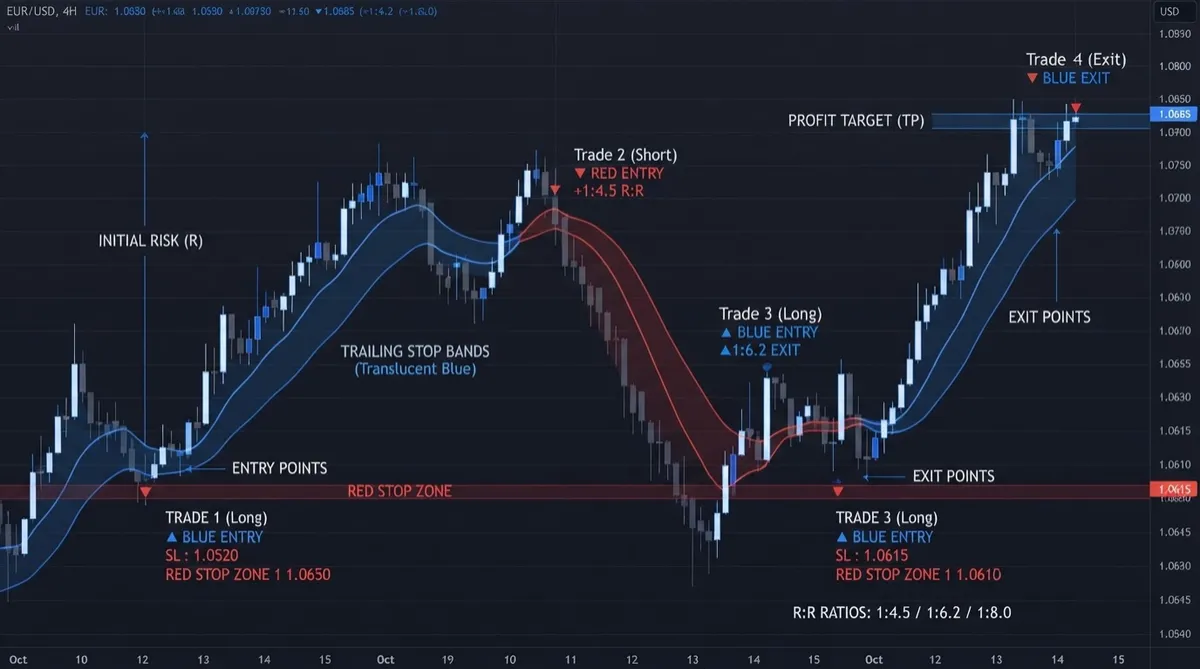
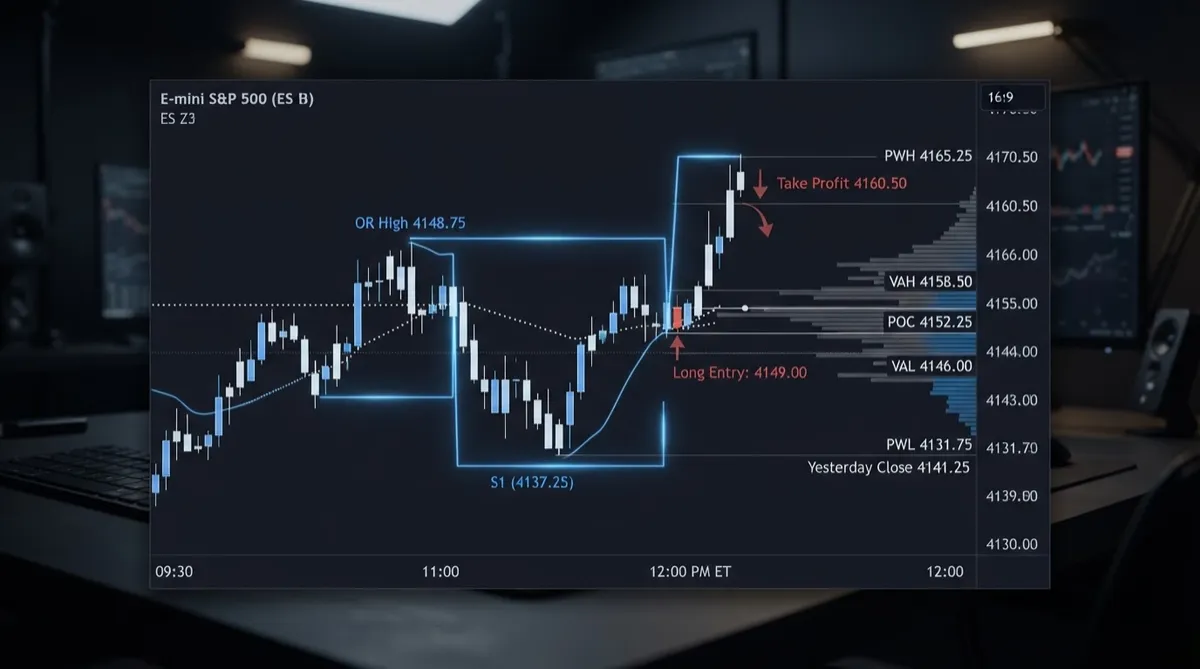
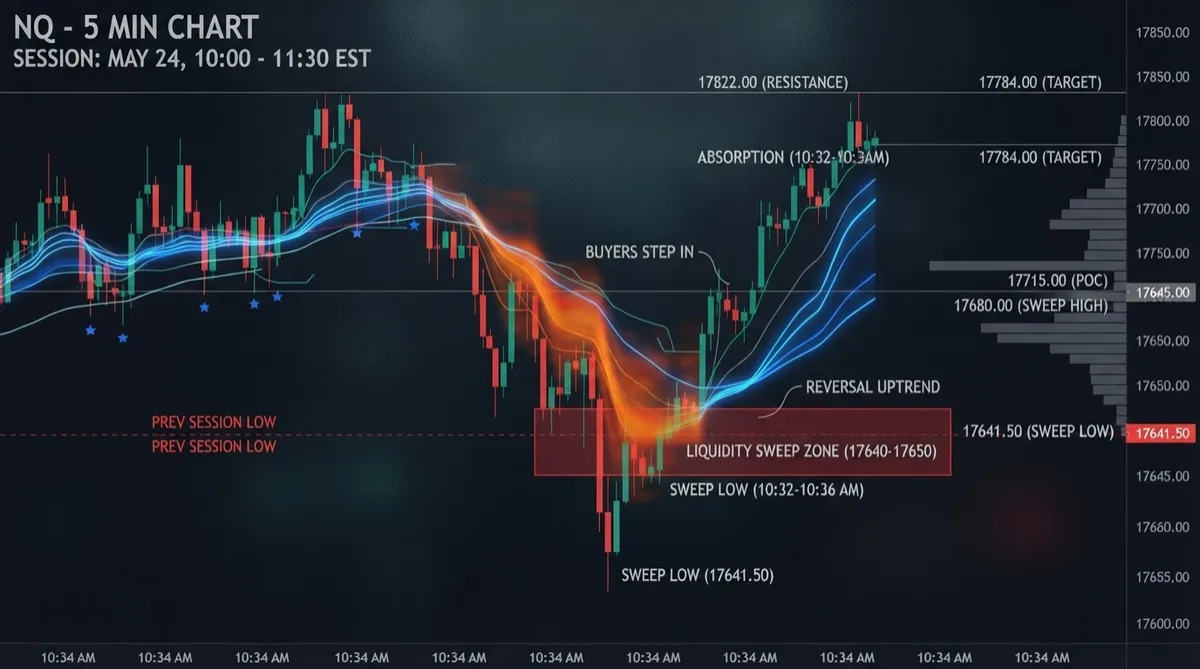
New in-depth trade recaps published weekly : 100% free educational breakdowns
TRANSPARENCY FIRST
Clear Answers on
Risk & Software
We operate with total candor. We do not sell get-rich illusions, hype alerts, or guaranteed returns. Review the exact operational parameters and software requirements below before taking action.
Is this a signal service or automated trade copier?
No. WP Signal Systems is strictly a technical trading education platform and precision workflow software provider. We do not broadcast live buy/sell calls, trade copier links, or managed account services. Our sole purpose is teaching market auction theory and equipping you with execution tools to trade independently.
Do I need NinjaTrader 8 (NT8) to use the system?
NinjaTrader 8 is required only if you deploy the automated WP Trade Assistant execution brackets and proprietary chart add-ons. Our structural analysis theory, risk management blueprints, and core auction curriculum can be applied to any modern charting platform.
Is prior futures trading experience required?
No prior experience is necessary, but a serious commitment to strict risk discipline is mandatory. We guide beginners through market mechanics, contract specifications, and thorough simulator execution before risking live capital.
Does your software or methodology eliminate market risk?
Absolutely not. No algorithmic tool, indicator, or curriculum can eliminate market uncertainty or prevent drawdowns. Futures trading carries substantial financial risk. Our tools enforce structural discipline and risk limits to protect capital, not eliminate risk.
CFTC RULE 4.41 & STATUTORY RISK WARNING
Futures, options, and currency trading contain substantial risk of loss and are not appropriate for every individual. An investor could lose all or more than the initial capital invested. Only genuine risk capital should be deployed for trading. Past performance, whether real or simulated, is not indicative of future results. Hypothetical or simulated performance results possess inherent limitations: unlike an authentic performance record, simulated trading does not represent actual execution, may not factor liquidity constraints, and no representation is made that any account will or is likely to achieve profits similar to those illustrated.
WP Signal Systems delivers systematic technical market structure tools, quantitative order-flow suites, and professional execution frameworks engineered exclusively for serious futures traders.
Direct Inquiries
Connect with our quantitative market technicians to evaluate your prop firm rule compliance and execution platform setup.


© 2026 WP Signal Systems. All rights reserved. WP Signal Systems is a quantitative educational technology platform and does not provide individualized investment advice or broker-dealer transactions.